We gave 13 AI models screenshots of animated components from 21st and asked each one to write the component back. Almost every model handled the simple animations. Of the harder components, which react to the mouse or run on shaders, GPT-6.1 Sol rebuilt every one. The shaders were where the models split, and seeing their own render helped Claude Opus 5.5 and Claude Sonnet 5.5 the most.
The task
Each model got screenshots of one component, without its code or name, and had to write it back as a React file. For components that react to the mouse, the mouse is drawn into the screenshots.
We ran 13 models, each at its highest reasoning setting: GPT-6.1 Sol, GPT-6 Astra, Claude Opus 5.5, Claude Sonnet 5.5, Claude Fable 5.1, Kimi K3.1 Pro, Kimi K3, Gemini 4 Argon, Gemini 3.8 Flash, Qwen 3.8 Max, Muse Spark 1.3, MiMo v2.6 Pro and Grok 4.7.
For the harder components each model then got two rounds to fix its answer: we rendered its code, showed it screenshots of its own version next to the original, and asked it to fix the differences. The simple animations got one answer with no fixes.
We put each version next to the original and gave it one of three grades:
- Match: hard to tell apart from the original.
- Close: the same layout, colours and kind of motion, but details differ, like the number of blades in a shader or the speed of a loop.
- Off: a different picture, like rings where the original has blades.
An example of what a model got, the screenshots and the prompt:
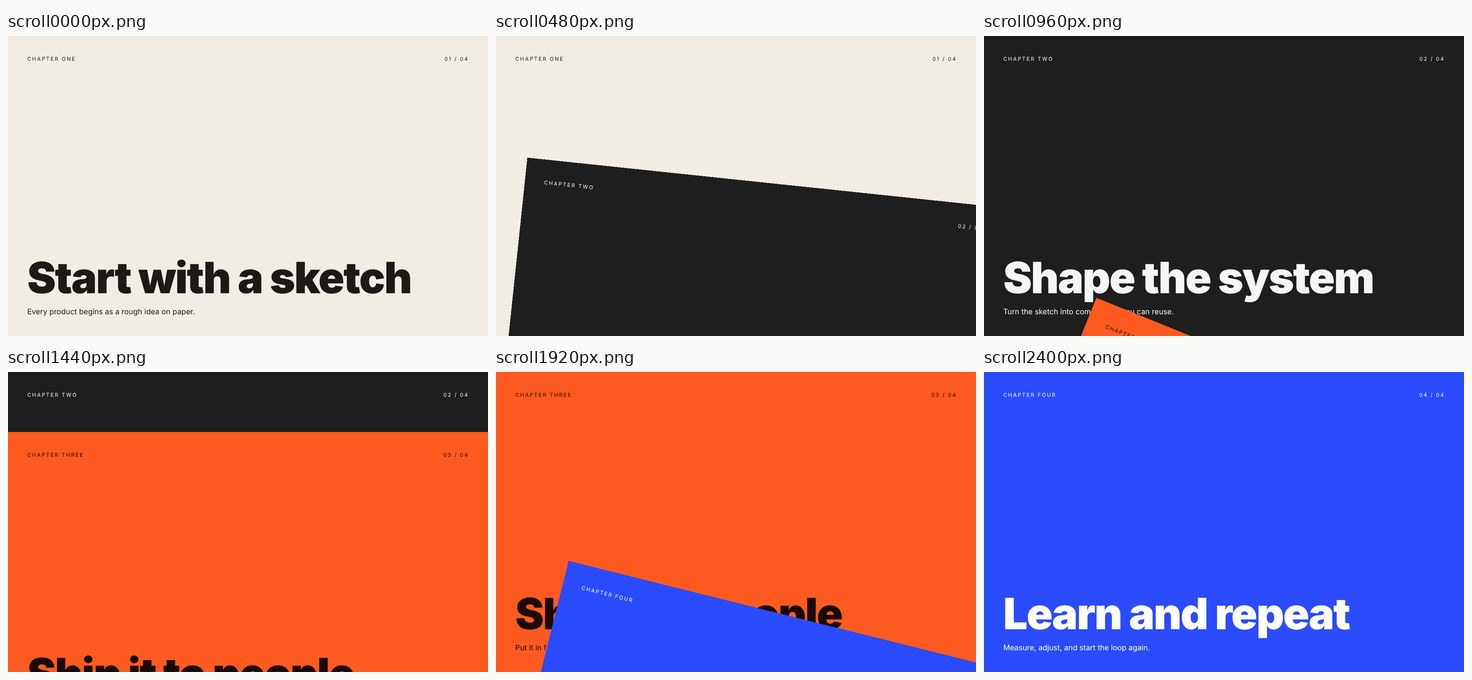 Six of the screenshots a model got for Story scroll
Prompt# Task: recreate a scroll-driven React page from frames

The folder `frames/` holds screenshots of one full page built in React, viewport 1280x800, captured
at the window scroll position in each file name (scrollY in pixels, 0 to 2400, every 80 px). The
page does nothing on its own; everything you see changes only because the user scrolls.

Write ONE file that recreates it as closely as you can: the same sections, colors, text,
layout and typography, and the same scroll behaviour (what moves at which scroll position,
from where to where, how it rotates, what stays in place, what covers what).

Rules:
- React 19 + TypeScript, Tailwind CSS v4 classes. Available packages: `react`, `framer-motion`,
  `gsap` (including `gsap/ScrollTrigger`), `@gsap/react`, `lucide-react`. Nothing else, no
  external URLs, images or fonts.
- `export default function App()` with no props. It is rendered full-page as the only thing on
  the page; the page itself must scroll (use the window scroll, not an inner scroll container).
- Write the file to the output path you were given. Do not build or run anything.
1. Simple animations
Four components with a fixed timeline: letters that fly apart, cards that turn in on scroll, a grid of looping widgets, and a hero over a moving gradient. Almost every model got them right. Each model answered once, with no revision.
All 13 models got the order and the timing of the flying letters. In every version the letters start to fly at the same moment as in the original. The differences are in the details:
- Gemini 3.8 Flash set the letters at about half the size with wide spacing, so the word reads like a caption.
- Grok 4.7 turns them only half as far on the way out, and blurs them instead of letting them fly off.
- Kimi K3.1 Pro matched the timing most closely: its letters disappear and its heading lands at the same moments as the original's.
›Show the other three simple animations
Story scroll
Most versions are hard to tell from the original: every chapter colour, the turned cards and the stacking are right. The differences:
- Grok 4.7 brings the cards in late and almost flat.
- Claude Opus 5.5 sets the headline so large that it wraps onto two lines.
- Qwen 3.8 Max tilts the cards more steeply than the original.
Living bento
- Claude Opus 5.5's version matches down to the details: at the same moment the radar sweep points at the same angle and the code block has typed up to the same character.
- Muse Spark 1.3 scales the whole grid up so the bottom row is cut off.
- Kimi K3's colour tile cycles through brown and green where the original goes from orange through teal and blue to violet.
Shader hero
No model reproduced the S-shaped wave behind the headline. The text, menu, buttons and spinning badge are right in every version.
- Claude Opus 5.5 drew a diagonal ridge.
- Qwen 3.8 Max drew a crumpled, rock-like texture.
2. Components that react to the mouse
Eight of the harder components change when the mouse moves.
Woven Light Hero is a knot of dotted rings behind a headline, and the dots scatter around the mouse. The final versions of all 13 models:
- GPT-6.1 Sol is hard to tell apart from the original, down to the dots scattering around the cursor.
- Kimi K3 lets the knot fall apart into dust that fills the screen.
- Muse Spark 1.3 draws a different knot, one tall twisted tube.
›Show the other seven components that react to the mouse
Liquid Metal Shader
- GPT-6 Astra matched it in its first answer, and GPT-6.1 Sol got there after the fixes.
- Muse Spark 1.3 draws a wall of grey tiles with a black hole in it.
- MiMo v2.6 Pro draws pale grey with sharp creases instead of dark liquid.
Reptile Smoke
- GPT-6.1 Sol, GPT-6 Astra and Gemini 4 Argon match.
- Gemini 3.8 Flash splits the smoke into a separate green ball and a pale cloud.
- Grok 4.7 fills the top of the page with one bright glow.
Fluid Swirl Shader
- Only GPT-6.1 Sol and GPT-6 Astra match.
- Claude Sonnet 5.5 draws a clean two-arm spiral without the marbling.
- Claude Fable 5.1 and Kimi K3 fill the centre with one blue pool.
Old Television Shader
- GPT-6.1 Sol, GPT-6 Astra, Claude Sonnet 5.5, Claude Opus 5.5 and Gemini 4 Argon match in the end.
- Gemini 3.8 Flash and Kimi K3 draw a smooth glow without the grain.
- Kimi K3.1 Pro puts a dark rectangle in the middle of the page.
Neural Noise
- Five models match: GPT-6.1 Sol, GPT-6 Astra, Claude Opus 5.5, Claude Fable 5.1 and Gemini 4 Argon.
- Muse Spark 1.3 draws a net of cells.
- Claude Sonnet 5.5 fills the page with thick pink loops.
Magnetic
- Social links that pull toward the mouse. Most models got the pull right, and in a still frame they all look alike.
- Grok 4.7 and Gemini 3.8 Flash set the links much smaller than the original.
Living Fluid Hero
- GPT-6.1 Sol, Claude Opus 5.5 and GPT-6 Astra match.
- Grok 4.7 makes the fiery blob larger and soft at the edges.
- Qwen 3.8 Max draws a small red blob on a grey page.
GPT-6.1 Sol, GPT-6 Astra and Claude Opus 5.5 got all eight in the end, and Grok 4.7 got none.
3. Shader backgrounds
Nine shader backgrounds that ignore the mouse. Most models matched the palette and missed the structure.
Radial Shader is a fan of curved blades turning around the centre. The final versions of all 13 models:
- GPT-6.1 Sol and GPT-6 Astra match it, blade for blade.
- MiMo v2.6 Pro draws cream petals, like a rose.
- Grok 4.7 draws one huge bright spiral around the cursor.
Claude Opus 5.5 first drew rings, then replaced them with blades after seeing its render next to the original:
›Show the other eight shader backgrounds
Iridescent Braided Shader
- GPT-6 Astra is the only match. GPT-6.1 Sol, Claude Sonnet 5.5 and Qwen 3.8 Max came close.
- Claude Opus 5.5 builds a tunnel of tubes.
- Gemini 3.8 Flash draws rows of identical diamonds converging on the centre, and Gemini 4 Argon a sharp kaleidoscope.
ATC Shader
- No model matched it, and seven came close.
- Gemini 3.8 Flash draws a bright white tunnel of rings.
- Grok 4.7 leaves the page almost black, and Muse Spark 1.3 leaves it blank white.
Background Shader
- GPT-6.1 Sol, GPT-6 Astra, Claude Opus 5.5, Claude Fable 5.1 and Gemini 4 Argon match.
- Gemini 3.8 Flash and Muse Spark 1.3 add sharp curved streaks of light.
- MiMo v2.6 Pro makes it much lighter, Kimi K3 dark navy, and Grok 4.7 flat blue.
Dithered Shader Background
- No model matched it in the end. GPT-6 Astra matched it in its first answer and lost it during the fixes: its final version has a bright square blob and stray lines.
- Claude Sonnet 5.5 draws something like a contour map.
- Kimi K3.1 Pro draws dark blocks, and Gemini 4 Argon flat grey rectangles.
GPT-6 Astra's first answer and its final version:
Fluid Particles Background
- GPT-6.1 Sol and GPT-6 Astra match.
- Gemini 3.8 Flash draws shaded bands instead of thin lines.
- Grok 4.7 fills the page with short dashes, like a field of hair.
Gateway Flow
- GPT-6.1 Sol, Claude Opus 5.5, GPT-6 Astra and Gemini 4 Argon match.
- Grok 4.7 draws one curve along the bottom instead of two fans meeting in the middle.
- Kimi K3.1 Pro leaves a gap where the fans should meet.
GLSL Hills
- GPT-6.1 Sol, GPT-6 Astra and Claude Opus 5.5 match. The headline is right in every version, and the differences are in the mesh behind it.
- Grok 4.7 draws one smooth dark ribbon.
- Qwen 3.8 Max draws tighter, more regular waves.
Shader Dithering
- GPT-6.1 Sol, GPT-6 Astra, Claude Sonnet 5.5, Claude Fable 5.1 and Gemini 4 Argon match.
- Qwen 3.8 Max draws a bright wavy band with hard steps.
- Claude Opus 5.5 gives the peak a sharp dark outline.
Shaders are where seeing their own render helped most. GPT-6.1 Sol went from 6 to all 9, and Claude Sonnet 5.5 from 4 to 8. GPT-6 Astra had 8 in its first answers and didn't need it. The hardest were Dithered Shader Background and Iridescent Braided Shader: only three and four models got them.
4. Canvas and 3D animations
A 3D gallery, three canvas animations, a loader and falling beams, none of which react to the mouse. This was the easiest group.
Flickering Grid Hero hides the 21st logo in a grid of faint, flickering dots. The final versions of all 13 models:
- GPT-6.1 Sol, GPT-6 Astra, Claude Sonnet 5.5 and Gemini 4 Argon match.
- Models that couldn't make out the logo drew their own: Grok 4.7 writes "20" in a grey circle, Muse Spark 1.3 writes "3D", and Kimi K3 a lowercase "a".
›Show the other five canvas and 3D animations
Spiral Loader
- Seven models match.
- Gemini 3.8 Flash draws a loop that crosses itself, and Grok 4.7 a blurry ring.
- Qwen 3.8 Max, Kimi K3 and Muse Spark 1.3 draw an open C instead of a spiral.
Entropy
- A grid of dots on the left and the same dots in chaos on the right. GPT-6.1 Sol, GPT-6 Astra and Gemini 4 Argon match.
- Grok 4.7 and Claude Fable 5.1 join the chaotic dots into a web of lines.
- Kimi K3 bends the ordered half into waves.
3D Orbit Gallery
- Seven models match.
- Grok 4.7 makes the cards much bigger, so they fill the page.
- Gemini 3.8 Flash looks at the ring from above, and Kimi K3 flattens the back row into a strip.
Digital Loom Background
- Every model got the headline and the button. GPT-6.1 Sol, GPT-6 Astra, Claude Sonnet 5.5, Claude Opus 5.5 and Gemini 4 Argon match.
- Grok 4.7 draws long straight lines across the page instead of drifting threads.
- Kimi K3 leaves the background almost empty.
Background Beams With Collision
- The only component that all 13 models got. It is a widely used open-source component, more on that below.
Seven models got all six. Background Beams With Collision is the only component all 13 models got.
Results
How many of the mouse, shader and canvas components each model matched or came close to, first from the screenshots alone and then after the two rounds of fixes:
The fixes helped the Claude models most: Claude Opus 5.5 matched or came close to 16 components in its first answers and 21 after the fixes, and Claude Sonnet 5.5 went from 14 to 20. GPT-6 Astra had 22 both times: its first answers were already right, and the fixes repaired one component and broke another.
All the numbers in one table. First answers is what a model wrote from the screenshots alone, and final is after the two rounds of fixes. Cost is the price of every call a model made in this test, failed attempts included:
| Model | Mouse, of 8 | Shaders, of 9 | Other, of 6 | First answers, of 23 | Final, of 23 | Cost |
|---|---|---|---|---|---|---|
| GPT-6.1 Sol | 8 | 9 | 6 | 19 | 23 | $24.59 |
| GPT-6 Astra | 8 | 8 | 6 | 22 | 22 | $138.48 |
| Claude Opus 5.5 | 8 | 7 | 6 | 16 | 21 | $59.02 |
| Claude Sonnet 5.5 | 6 | 8 | 6 | 14 | 20 | $25.89 |
| Claude Fable 5.1 | 7 | 7 | 6 | 17 | 20 | $215.22 |
| Kimi K3.1 Pro | 7 | 7 | 6 | 16 | 20 | $27.10 |
| Gemini 4 Argon | 7 | 6 | 6 | 15 | 19 | $37.52 |
| Qwen 3.8 Max | 3 | 5 | 4 | 9 | 12 | $17.73 |
| Muse Spark 1.3 | 2 | 4 | 4 | 9 | 10 | $9.92 |
| MiMo v2.6 Pro | 5 | 1 | 4 | 8 | 10 | $1.79 |
| Kimi K3 | 3 | 3 | 2 | 8 | 8 | $16.13 |
| Gemini 3.8 Flash | 2 | 2 | 3 | 6 | 7 | $12.27 |
| Grok 4.7 | 0 | 1 | 3 | 5 | 4 | $42.45 |
| Blank page (control) | 0 | 0 | 0 | 0 | 0 | – |
Some of what went wrong:
- GPT-6 Astra: revising broke Dithered Shader Background, which its first answer had matched.
- Claude Fable 5.1: on Spiral Loader it spent all 128k output tokens reasoning and wrote no code. It worked at medium reasoning.
- Grok 4.7: on both dithering shaders it replied that it would inspect the frames and wrote no code, even when asked again. It took medium reasoning on one and low on the other. Three revision rounds came back without code.
Four models at their highest reasoning setting returned no code at least once, mostly because reasoning used up all the output tokens; retries at a lower setting got code from all four.
What the models remembered
Background Beams With Collision is the only component all 13 models got. It is a widely used open-source component from Aceternity UI, and in an earlier run Claude Opus 5.5 wrote back the original code nearly line for line. Neural Noise, a widely copied shader, came back almost pixel for pixel from five models. None of the more than 1,100 files the models wrote embeds or downloads an image.
Takeaways
- GPT-6.1 Sol got every component right or close after the fixes, and it was the cheapest of the six models that got 20 or more.
- Seeing its own render next to the original mattered almost as much as the model: with it, Claude Sonnet 5.5 went from 14 to 20 and caught up with Claude Fable 5.1, which cost eight times more.
- Simple animations are mostly solved. Shaders split the models: GPT-6 Astra got 8 of the 9 in its first answers and GPT-6.1 Sol all 9 after the fixes, while most other models got the colours right and the structure wrong.